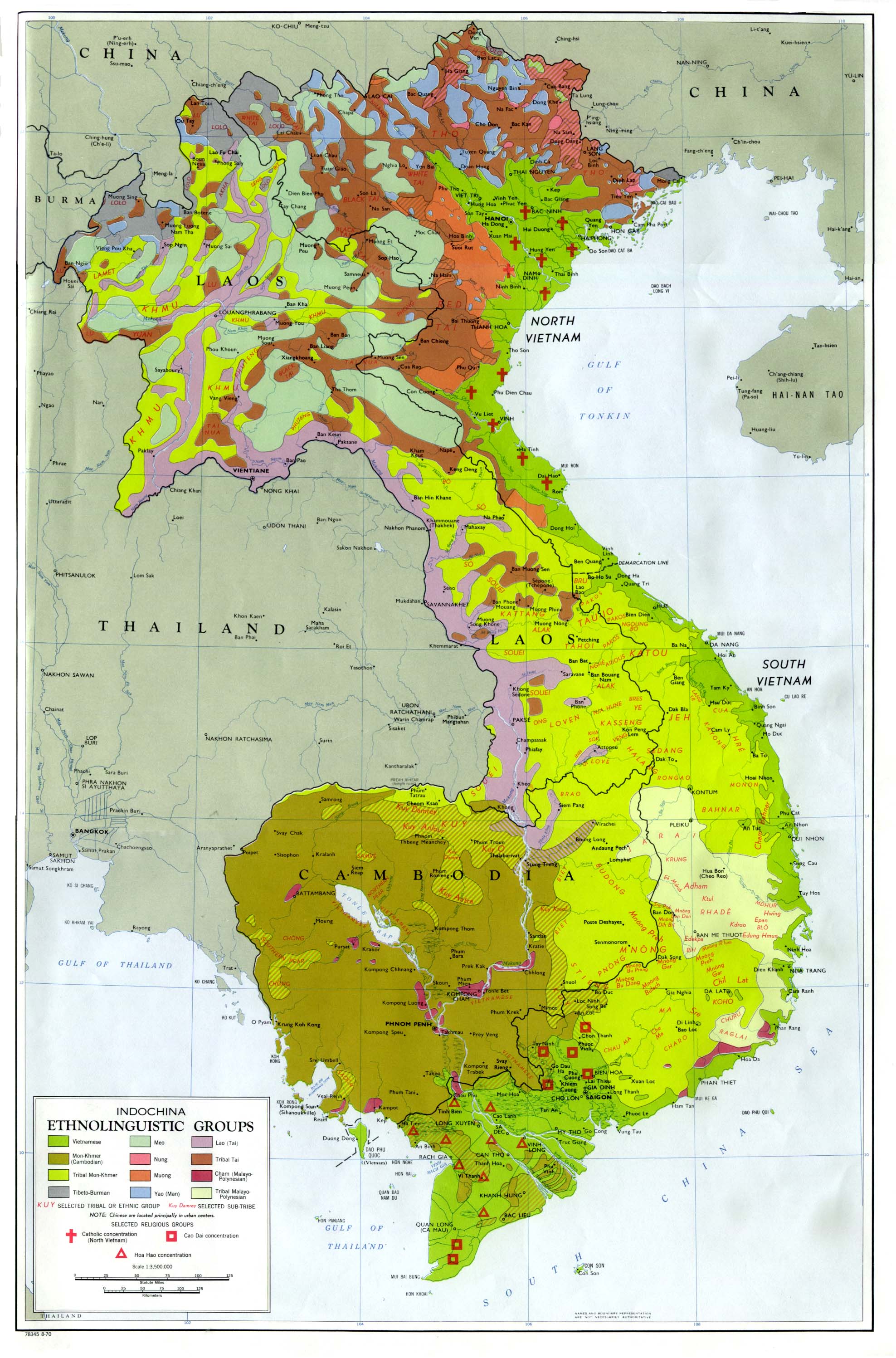
The Inti are a small ethnic group living exclusively in Laos, primarily in Attapeu Province's Sanamxay District in the country's southeast. They speak the Oy language, which identifies them culturally and linguistically within the Mon-Khmer (Austroasiatic) language family — the same broad category as many other indigenous groups in southern Laos.
Historical records about the Inti's origins and migrations are limited, as they have lived in these upland areas for generations with minimal outside influence documented. Their ancestry likely shares deep roots with other Mon-Khmer peoples who settled the rugged forests and hills of Laos long before modern national borders formed.
The Inti live in rural, often remote villages where daily life centers on agriculture, family, and community cooperation. They typically reside close to fields where they farm rice and other local crops suited to the climate and terrain, relying on village networks for labor and mutual support. Families usually work together in subsistence farming, raising livestock such as chickens, pigs, or water buffalo for food, labor, and cultural obligations. Children often help in the fields or with household tasks from a young age, strengthening inter-generational ties and passing down traditional skills. Social life revolves around family, clan connections, village gatherings, seasonal cycles, and shared labor. Although some modern influences reach these communities, many Inti continue long-standing patterns of life rooted in their ancestral homeland.
The majority of the Inti people identify as Buddhists (about 93%). They practice Theravada Buddhism, which Laos broadly shares as a national religion, but their religious expression often blends Buddhist teachings with local cultural traditions and spirit beliefs that honor ancestors and unseen forces connected to nature and social life. Because Buddhism is deeply woven into community life — especially temples, rituals, and festivals — many Inti interpret life's challenges and success through both Buddhist teaching and local customs. Their worldview reflects respect for elders, reverence for traditions, and a desire for spiritual harmony. A small but notable minority (5–10%) identify as Christians, mainly through recent evangelistic contact, and this group makes up the basis of the community's current Christian witness.
The Inti have partial reach of the gospel, with relatively low Christian presence but some existing believers. They still lack full access to Scripture and ministry resources in Oy, their heart language. The JESUS Film and audio Scripture recordings that share the gospel clearly and engagingly would further a movement to Christ. The Inti desperately need ministry workers who understand both Inti culture and Buddhist backgrounds, able to build trust and walk relationally with the community. Support for existing Inti believers will be needed so they can grow in faith and serve as bridges to their families and neighbors. They also need holistic community development such as education, healthcare, and livelihood support that respects local customs and fosters dignity.
Pray that the Inti would experience deep encounters with Jesus, moving beyond superficial understanding to genuine transformation.
Pray for Bible translation efforts and ministry materials in the Oy language to multiply quickly.
Pray that the JESUS Film and audio Scripture materials would be widely heard and clearly understood.
Pray for loving workers with patience and cultural sensitivity to live among the Inti and build life-on-life relationships.
Pray for spiritual openness among Inti families, especially community leaders and elders.
Pray for a movement to Christ that grows organically within Inti social networks — in villages, families, and youth groups.
Pray that the Inti would soon have healthy, growing churches that equip believers to share the gospel with others.
Scripture Prayers for the Inti in Laos.
The identity of Katu Ethnic Group (Lao PDR), Open Development Mekong https://data.opendevelopmentmekong.net/library_record/the-identity-of-katu-ethnic-group-lao-pdr
Katu overview, Traditional Arts and Ethnology Centre (TAEC) https://www.taeclaos.org/
| Profile Source: Joshua Project |